Make splats
Check a set of posed views and reconstruct it once as Gaussian splats.
posedImages2Splats reconstructs a scene from posed views with depth and refines it into an SPZ file. Start from a scene with views around it.
Treat the reconstruction as the final step. A run takes 15 to 25 minutes and costs 5,000 credits ($5). While refining, it generates its own dense views, which it does not return. What you control is the set of views you submit, so check that set first. The views are the preview of the result.
1. Check the views as input
The posed frames and the generated views you kept are the input.
- Coverage. Every area you want to look at should appear in at least one view: the floor, low furniture, walls, and the far side of anything you will move around. Areas no view shows come out blurry or invented.
- Agreement. An object with a different shape or place in two views becomes a doubled, ghosted object. Remove the view that disagrees.
- Format. Every frame needs depth, and all frames use one size.
For a single room, 8 to 16 views in all is a good range. To add coverage,
generate more views with the current ones as contextFrames and returnDepth
set to true. Splat best practices shows examples of
coverage and agreement problems.
2. Reconstruct once
List each frame's image, depth, and camera in posedFrames:
Submit without waiting, keep the operation ID, and wait on it separately:
If waiting times out, wait again. Do not submit the request again while the operation is running; a second run is a second charge.
3. Use the result
The SPZ file uses the same world as the cameras you submitted. View it with Spark or in Blender, or pass its asset to splats2Mesh for a mesh.
Example
Continuing the potter's studio: the posed image and the seven views, eight frames in all. The run took 18 minutes and returned 2,000,000 splats.
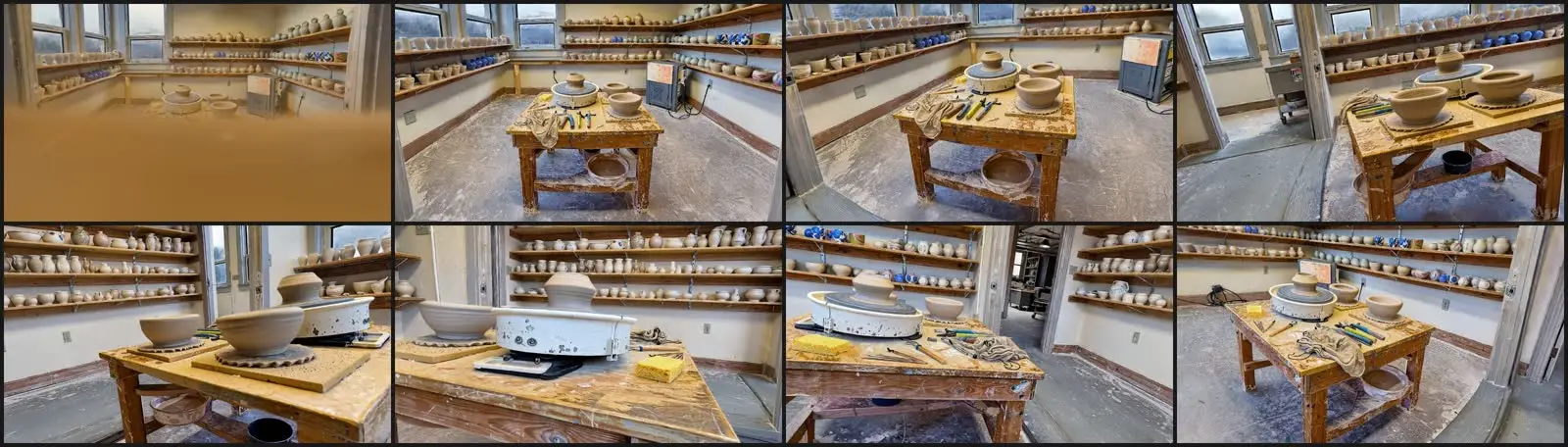 The splats rendered from eight new positions: at the original camera, then inside the room around the table.
From inside the room, the scene holds together from every side. From the original camera's position, a blurred surface covers the lower part of the view. The door threshold and frame were close to the lens and only the source image showed them. Surfaces that a single view sees at close range are a place to add another view.